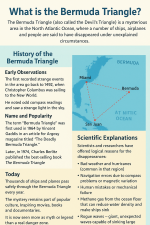
What is the Bermuda Triangle?
The Bermuda Triangle (also called the Devil’s Triangle) is a mysterious area in the North Atlantic Ocean where a number of ships, airplanes, and people are said to have disappeared under unexplained circumstances.
It forms a rough triangle between three points:
- Miami, Florida (USA)
- Bermuda (a British island in the Atlantic)
- San Juan, Puerto Rico
The total area of this triangle is about 500,000 to 1,500,000 square miles of ocean.
Although many mysterious stories are told about it, scientists have found no proof that anything supernatural happens there. Still, it remains one of the world’s most famous mysteries.
📜 History of the Bermuda Triangle
🕰️ 1. Early Observations
- The first recorded strange events in the area go back to 1492, when Christopher Columbus was sailing to the New World.
- He noted odd compass readings and saw a strange light in the sky, but nothing dangerous occurred.
✈️ 2. The 20th Century — Rise of the Mystery
The legend of the Bermuda Triangle began to grow in the 1900s, when several ships and aircraft went missing in the region.
🚢 Notable Disappearances:
▪ USS Cyclops (1918)
- A U.S. Navy ship carrying 309 people vanished without a trace.
- No distress call, no wreckage ever found.
▪ Flight 19 (1945)
- Five U.S. Navy bombers disappeared during a training flight.
- Pilots reported compass problems before losing contact.
- A rescue plane sent to search for them also vanished.
▪ Star Tiger and Star Ariel (1948–1949)
- Two British passenger planes disappeared while flying across the Triangle.
These events made the area famous as a “danger zone.”
🗞️ 3. Name and Popularity
- The term “Bermuda Triangle” was first used in 1964 by Vincent Gaddis in an article for Argosy magazine titled “The Deadly Bermuda Triangle.”
- Later, in 1974, author Charles Berlitz published the best-selling book The Bermuda Triangle, which made the mystery world-famous.
🔍 4. Scientific Explanations
Scientists and researchers have offered logical reasons for the disappearances, such as:
- Bad weather and hurricanes (common in that region).
- Navigation errors due to compass problems or magnetic variation.
- Human mistakes or mechanical failure.
- Methane gas from the ocean floor that can reduce water density and make ships sink.
- Rogue waves — giant, unexpected waves capable of sinking large vessels.
Modern investigations by the U.S. Coast Guard and NOAA (National Oceanic and Atmospheric Administration) have found no evidence that the Bermuda Triangle is more dangerous than any other part of the ocean.
🌐 5. Today
- Thousands of ships and planes pass safely through the Bermuda Triangle every year.
- The mystery remains part of popular culture, inspiring movies, books, and documentaries.
- It is now seen more as a myth or legend than a real danger zone.
🧭 In Short
| Topic | Details |
|---|---|
| Location | Between Miami, Bermuda, and Puerto Rico |
| Also Known As | The Devil’s Triangle |
| First Mentioned | 1964 by Vincent Gaddis |
| Famous Incidents | Flight 19 (1945), USS Cyclops (1918) |
| Scientific View | Disappearances caused by natural or human factors |
| Cultural Impact | One of the world’s biggest ocean mysteries |