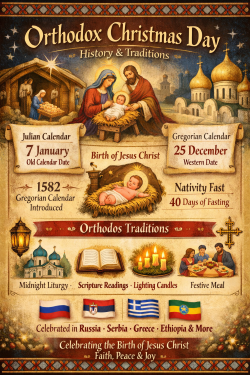
Orthodox Christmas Day is celebrated by many Eastern Orthodox Christians on 7 January each year. This difference in date from Western Christmas (25 December) comes from the use of different calendars.
📜 Historical Background
Orthodox Christians follow the Julian Calendar, which was introduced by Julius Caesar in 45 BCE. Over time, this calendar became slightly inaccurate in calculating the solar year.
In 1582, Pope Gregory XIII introduced the Gregorian Calendar, which corrected this drift. Most Western Christian churches adopted the Gregorian Calendar, but many Orthodox churches chose to continue using the Julian Calendar for religious festivals.
As a result:
- 25 December (Julian Calendar) falls on 7 January (Gregorian Calendar)
- Hence, Orthodox Christians celebrate Christmas on 7 January
✝️ Religious Significance
Orthodox Christmas marks the birth of Jesus Christ, the Son of God, who Christians believe came to Earth to bring salvation to humanity.
The celebration follows a 40-day fasting period known as the Nativity Fast, which begins on 15 November (Julian calendar). Christmas Day itself is a time of joy, prayer, and thanksgiving.
🕯️ Traditions & Customs
Common Orthodox Christmas traditions include:
- Attending midnight or early morning church services
- Reading biblical accounts of Christ’s birth
- Lighting candles to symbolize Christ as the Light of the World
- Sharing festive meals with family after fasting ends
- Special hymns and prayers called troparia and kontakion
In countries like Russia, Serbia, Ukraine, Greece (Old Calendar followers), Ethiopia, and parts of the Middle East, Orthodox Christmas is a major religious and cultural celebration.
🌍 Difference from Western Christmas
| Western Christianity | Orthodox Christianity |
|---|---|
| Celebrated on 25 December | Celebrated on 7 January |
| Uses Gregorian Calendar | Uses Julian Calendar |
| Shorter Advent period | 40-day Nativity Fast |
✨ Conclusion
Orthodox Christmas Day is deeply rooted in ancient Christian tradition and calendar history. While the date differs, the core message remains the same: celebrating the birth of Jesus Christ, peace, faith, and hope.